

The Best GPS Running Watches to Buy in 2026
Whether you’re training for your first 5K, chasing a marathon personal best, or simply trying to stay consistent with your weekly runs, a quality GPS running watch can transform the way you train. Today’s best running watches do much more than record distance and pace—they analyse your performance, monitor your recovery, track your sleep, guide your workouts, and even help you navigate unfamiliar trails.
The challenge is deciding which one to buy.
The GPS running watch market has never been more competitive. Garmin continues to dominate with its feature-rich Forerunner and Fenix series, while COROS has become a favourite among endurance athletes thanks to exceptional battery life. Polar remains a strong choice for heart rate and training insights, Suunto excels in outdoor adventure, and Amazfit offers surprisingly capable watches at budget-friendly prices.
With so many excellent options available, choosing the right watch isn’t simply about buying the most expensive model. The best GPS running watch is the one that matches your goals, training style, and budget.
Some runners want every possible training metric, including VO2 Max estimates, training readiness, recovery recommendations, and advanced race predictions. Others simply need accurate GPS tracking, reliable pace measurements, and enough battery life to get through a marathon or an ultramarathon. Many runners also want smartwatch features like music storage, contactless payments, phone notifications, and health tracking without sacrificing battery life.
To help you find the perfect fit, our team spent months evaluating the latest GPS running watches from the biggest brands. We tested them on roads, trails, tracks, treadmills, and long-distance races. We compared GPS accuracy, heart rate performance, battery life, comfort, display quality, software experience, navigation, and overall value.
Rather than recommending the most expensive watch in every category, we focused on identifying the models that deliver the best experience for different types of runners. Whether your budget is under £250 or over £700, there’s an option here that will help you train smarter and enjoy every mile.
Our Favourite GPS Running Watches of 2026
| Category | Watch |
|---|---|
| Best Overall | Garmin Forerunner 970 |
| Best Value | Suunto Run |
| Best Budget | Amazfit T-Rex 3 Pro |
| Best Battery Life | COROS Pace 4 |
| Best for Triathletes | Garmin Forerunner 975 |
| Best Trail Running Watch | Garmin Fenix 8 |
| Best Lightweight Watch | COROS Pace 4 |
| Best Premium Watch | Garmin Epix Pro (Gen 2) |
| Best Smartwatch for Runners | Apple Watch Ultra 3 |
| Best Recovery Insights | Polar Vantage V4 |
Why You Can Trust Our Recommendations
Every watch in this guide was evaluated using the same criteria to provide fair comparisons across brands and price ranges. During testing, we considered:
- GPS accuracy on roads, trails, and tree-covered routes
- Optical heart rate accuracy during easy and hard workouts
- Battery life during real-world GPS use
- Comfort for daily wear and long runs
- Display brightness in sunlight
- Navigation and mapping capabilities
- Ease of use and companion app quality
- Training metrics and coaching features
- Durability in various weather conditions
- Overall value for money
We also compared each watch with its predecessor and with similarly priced competitors to determine whether it genuinely represents an upgrade.
How to Choose the Right GPS Running Watch
Before diving into our reviews, consider what matters most to your training.
Buy for Your Running Goals
If you’re just starting your running journey, you probably don’t need hundreds of advanced metrics. A watch with reliable GPS, heart rate tracking, and a comfortable design will cover nearly everything you need.
More experienced runners often benefit from features like structured workouts, race predictors, interval training, recovery metrics, lactate threshold estimates, and advanced pacing tools.
Trail runners should prioritise battery life, breadcrumb navigation, offline maps, rugged construction, and altimeter accuracy.
Triathletes need dedicated multisport modes that allow seamless transitions between swimming, cycling, and running.
Battery Life Matters More Than You Think
Battery life isn’t just about convenience.
Longer battery life means you can complete marathon training, ultramarathons, hiking trips, or multi-day adventures without constantly worrying about charging. Even if you mainly run short distances, fewer charging sessions make a watch much more enjoyable to own.
Accuracy Is Everything
Fancy features don’t matter if the basics aren’t reliable.
A quality GPS running watch should consistently deliver accurate pace, distance, elevation, and heart rate measurements. These metrics influence every training decision you’ll make, from pacing intervals to calculating recovery.
That’s why our recommendations prioritise real-world accuracy before flashy extras.
Quick Buying Advice
If you simply want the best GPS running watch available today, the Garmin Forerunner 970 earns our top recommendation thanks to its outstanding balance of performance, battery life, training tools, and everyday usability.
If you’re shopping on a tighter budget, the Suunto Run offers exceptional value without feeling stripped down.
And if maximum battery life is your top priority, the COROS Pace 4 remains one of the most impressive endurance-focused running watches available in 2026.
In the following sections, we’ll break down each watch in detail, highlighting its strengths, weaknesses, ideal user, and whether it’s worth your money.
Pros:
- Best-in-class feature set for runners, with frequent software updates
- Lightweight and comfortable enough for all-day wear
- Exceptionally fast performance
Cons:
- Excellent battery life, but not the longest in its class
- Steep learning curve for new users
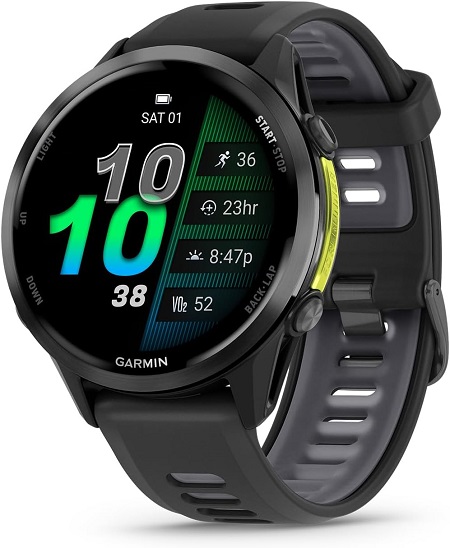
Having tested the Garmin Forerunner 970 over the past four months, I can confidently say it’s the most complete GPS running watch Garmin has produced to date – and currently the strongest all-round option on the market.
With rivals such as Amazfit and Huawei improving at an impressive pace, alongside established names like Coros, Suunto and Polar, Garmin has managed to retain its position at the top with the Garmin Forerunner 970. The gap between brands has narrowed in terms of hardware innovation, but Garmin continues to lead when it comes to ecosystem integration, training analysis and overall user experience.
The Garmin Forerunner 970 sits just below the Fenix range in Garmin’s line-up, costing around £50 less than the entry-level Fenix 8. While the Fenix is often seen as the watch for trail runners and adventure athletes, the 970 delivers almost all of the same functionality in a lighter, more wearable package that’s easier to live with every day.
Compared with the mid-range Garmin Forerunner 970, which previously topped this guide, the 970 offers longer battery life, more premium materials and a broader feature set.
From a hardware perspective, wearability is one of its greatest strengths. At just 56g, it’s light enough that you quickly forget you’re wearing it – a significant advantage over bulkier adventure-focused models such as the Fenix or Enduro. The upgraded AMOLED display is bright, vibrant and easy to read without feeling overly saturated.
Garmin’s five-button interface remains one of its standout features. Physical controls are simply more dependable during sweaty training sessions, cold-weather runs or when wearing gloves. Once you’ve learnt the menu structure, navigation becomes intuitive, although the sheer depth of features does mean there’s a noticeable learning curve.
GPS performance is excellent. Multi-band, multi-GNSS support provides consistently accurate positioning across both roads and trails, while pace readings remain stable during intervals and sudden changes in speed. Under dense tree cover, between steep valley walls and through tight switchbacks, the watch maintains impressive reliability. Satellite acquisition is rapid, and recorded tracks look clean and believable, even in environments that often confuse less capable sensors.
Battery life strikes a sensible compromise. You can expect around 23 hours using multi-band GNSS with all satellite systems enabled, or roughly 13 days in smartwatch mode. That’s comfortably enough for marathons, 50km races and demanding training weeks without constantly reaching for the charger.
It won’t rival ultra-endurance watches such as the Suunto Vertical or Coros Vertix 2S for outright battery longevity, but that’s the trade-off for a lighter, more comfortable watch that’s easier to wear every day. You may need to charge it a little more often, but you’re also far more likely to wear it consistently and make better use of Garmin’s daily health and training insights.
Although it’s primarily aimed at road runners and triathletes, the Forerunner 970 includes genuinely useful features for trail runners too. One of the highlights is Trail Run Auto Climb, which automatically switches to a dedicated climbing data screen during ascents, allowing you to monitor vertical gain, gradient and pacing without manually changing screens.
It also calculates Grade Adjusted Pace (GAP), translating your effort on hills into an equivalent pace on flat ground. This makes pacing on climbs far easier to judge and allows for much more meaningful comparisons across different terrain than simply reviewing splits afterwards. Previously, GAP was largely something you analysed in Strava after a run; now it’s available in real time on your wrist.
Another welcome addition is Hill Score, which measures your climbing ability using data from recent runs. Rather than relying solely on VO₂ max, it tracks improvements in climbing strength and efficiency, making it particularly valuable for runners tackling hilly or mountainous races.
Navigation is every bit as good as it is on the Fenix range. Offline mapping, GPX route support, turn-by-turn navigation, round-trip route generation and off-course alerts combine to create a genuinely capable navigation tool, allowing you to explore unfamiliar routes confidently without relying on your phone.
The 970 also features a built-in LED torch with four brightness settings and a red light mode. Whether you’re making a quick trip to the bathroom during the night or, more usefully, activating the flashing strobe mode to make yourself more visible on evening runs, it’s one of those features that initially sounds gimmicky but quickly proves its worth.
Away from training, the 970 is a highly capable smartwatch. Voice controls, offline music storage and Spotify support, smartphone notifications and comprehensive lifestyle tracking all add to its appeal. Garmin has also expanded its wellness logging, allowing you to record habits and recovery factors with prompts such as “Did you cold plunge today?”, “Did you drink alcohol today?” and “Which shoes did you wear?” These additions make it a far more rounded device than one focused solely on running metrics.
If you’re looking for outstanding GPS accuracy, industry-leading training analysis, excellent navigation and a watch that’s comfortable enough to wear every day, the Forerunner 970 currently offers the most complete package available.
It’s undeniably expensive, and the learning curve shouldn’t be underestimated. However, for runners who want flagship performance without the size and weight of a more adventure-focused watch, the Forerunner 970 stands at the head of the field.