

Two Crew Members Killed After Firefighting Helicopters Collide in Greece as British Pilot Survives
Two crew members have been killed after two helicopters collided mid-air in Greece while taking part in efforts to tackle wildfires.
The victims were a Danish pilot and a Greek fire service liaison officer. A British pilot and another Greek coordinator, who were aboard the second helicopter, survived the collision.
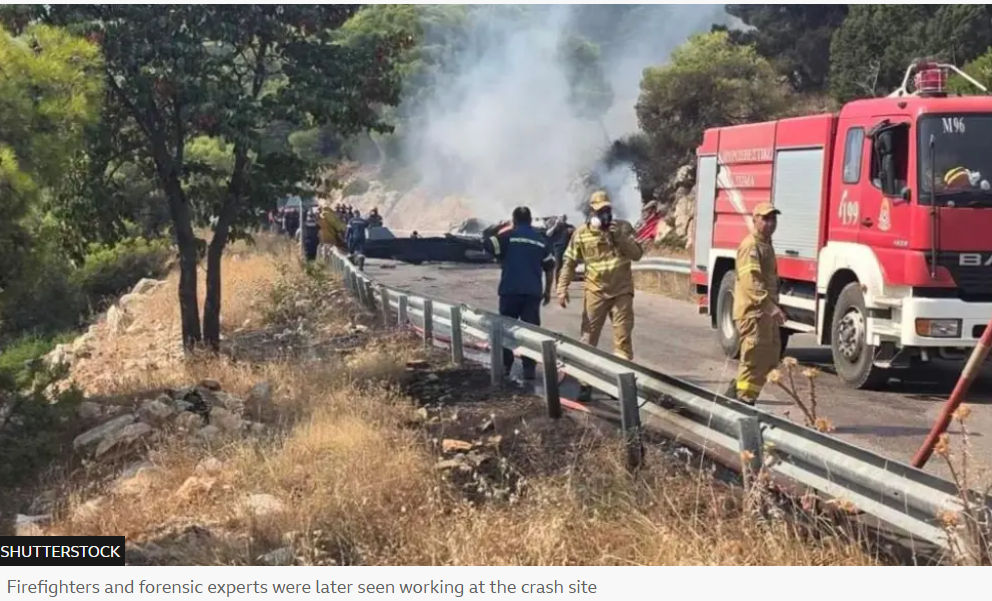
Video of the incident, which occurred around 65km (42 miles) west of the capital Athens, shows one of the two Bell helicopters striking the propellers of the other aircraft. The helicopter then bursts into flames before crashing into a ravine, while the other aircraft makes an emergency landing.
Wildfires have erupted across Greece this week, prompting mass evacuations as firefighters battle to contain the flames. Other parts of Europe have also been hit by devastating wildfires amid prolonged periods of extreme heat.
According to the Greek Fire Service, the two leased Bell helicopters collided on Sunday while taking part in firefighting operations on the Attica-Boeotia border.
The crew of one helicopter were rescued alive, while the two people aboard the second aircraft were found unconscious and later pronounced dead.
Greek Prime Minister Kyriakos Mitsotakis expressed his “deepest sorrow” following the accident.
In a post on X, he said the deaths of the Greek coordinator and Danish pilot “fills us all with grief”. He also offered his condolences to their families.
As a precaution and in accordance with protocol, all Bell helicopters operating in Greece have been grounded, a source from the civil protection ministry told the BBC.
The source said the second Bell helicopter involved in the collision made an emergency landing in an area of low vegetation.
“The two people on board, a British pilot and a Greek fire service liaison officer – escaped with minor injuries,” the source said.
“Both remained conscious and have been admitted to hospital, where they will remain under observation for 24 hours as a precaution.”
The source also told the BBC that the British survivor was a private pilot hired for the wildfire season.
He was not involved in any exchange programme between the UK and Greece, and Athens had not requested assistance from the UK.
Meanwhile, Greek news website Ekathimerini reported that the two survivors immediately alerted authorities to the collision and helped guide rescuers to the crash site.
The names of the four crew members have not been publicly released.
Erickson Air-Crane and Chinook helicopters, along with Canadair water-bombing aircraft, are continuing to support firefighting operations.
Earlier this week, France and Spain also battled major wildfires, with two of the largest blazes located near Madrid and Bordeaux respectively. The fires have now been contained, although they continue to burn. Around 300,000 people who were evacuated have begun returning to their homes.
In Greece, media reports have described “a titanic battle” across a wide area including Porto Germeno, Psatha, Fokida, Megara and Kefalonia, where more than 500 firefighters have been working to bring the fires under control over the past 72 hours.
Most wildfires are started by people, either deliberately or accidentally. However, climate change is contributing to conditions that make wildfires increasingly common and difficult to control.
Last winter was mild and wet, encouraging vegetation to grow. That vegetation has subsequently dried out during successive periods of hot weather, creating additional fuel for wildfires.