
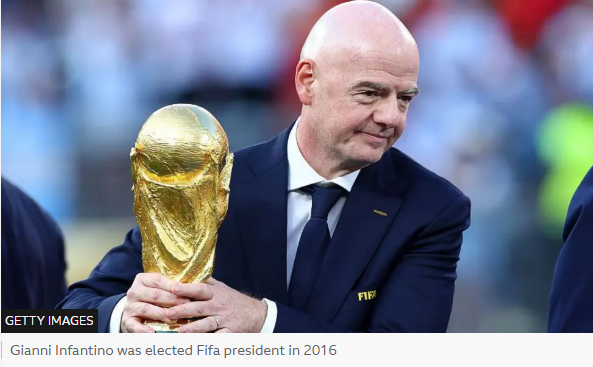
A bruising 24 hours: What’s next for FIFA and embattled Infantino?
A week is a long time in politics. Football politics.
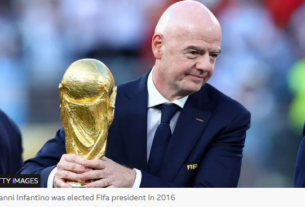
On Tuesday morning, Gianni Infantino looked untouchable. As Fifa president, he occupied the most powerful position in world football.
Just days later, that authority has been severely undermined.
After attempting to sell stakes in Fifa competitions to private investment firms — apparently without the knowledge of many of the game’s most senior figures — Infantino is facing the biggest challenge of his presidency.
His fiercest critics at Uefa delivered the decisive blow on Thursday, threatening to boycott every Fifa competition, including the World Cup. European football’s governing body now senses a rare opportunity to remove him — and perhaps the best chance it will ever have.
But the backlash extends far beyond Europe.
Concacaf, the confederation that worked closely with Infantino to deliver the 2026 World Cup, has called for a “full review” of Fifa’s leadership in response to his proposal.
Perhaps even more damaging, several of his traditionally loyal allies within the Asian Football Confederation (AFC) also turned against him.
Then came the departure of two of his closest confidants — first senior adviser Carlos Cordeiro, followed by chief operating officer Kevin Lamour.
Although Infantino abandoned the investment plan in the early hours of Saturday morning, the retreat did little to ease the pressure. Hours later, Uefa declared it had lost confidence in his leadership.
The battle lines have now been drawn. So what happens next? And how could Infantino be forced from office?
The quickest route would be voluntary resignation, as Sepp Blatter chose in 2015.
For now, however, Infantino still retains significant support and could instead try to ride out the storm until March, when he is due to seek a fourth and final term as Fifa president.
If he refuses to step aside, attention will turn to Fifa’s governance mechanisms.
The first option would be an emergency meeting of the Fifa Council, which can be convened if 19 of its 37 members request one.
Uefa holds nine seats, the AFC seven, Concacaf five, Africa six, Conmebol five and Oceania three, alongside Infantino and secretary general Mattias Grafstrom.
BBC Sport understands there is scepticism over whether the required 19 votes currently exist.
Should that threshold be reached, the meeting would have to take place within two weeks. Council members could call on Infantino to resign, although he would be under no obligation to comply.
Even so, such a public confrontation would significantly increase the pressure.
The next stage would be an extraordinary congress of Fifa’s 211 member associations. Under Fifa statutes, this must be convened if one-fifth of members — 43 associations — submit a written request.
With 55 member associations, Uefa alone has enough votes to trigger that process whenever it chooses.
The congress would almost certainly not take place for at least two months, and more likely three. Success would also be far from guaranteed.
In effect, it would become a vote of confidence in Infantino’s leadership, requiring a majority of 106 votes to remove him.
The regional voting blocs are split between Uefa’s 55 members, Africa’s 54, Asia’s 46, Concacaf’s 35, Oceania’s 11 and Conmebol’s 10.
Notably, Africa, Conmebol and Oceania have stopped short of publicly criticising Infantino’s investment proposal.
While 136 member associations officially rejected the plan, opposing a commercial proposal is not necessarily the same as voting to remove the president.
Some cracks have already emerged. Qatar has publicly backed Infantino, while Mexico has distanced itself from Concacaf’s collective statement.
That raises another challenge for his opponents: identifying a credible alternative before the presidential election in March.
Infantino was re-elected unopposed in both 2019 and 2023. Any challenger must declare their candidacy by 18 November.
Who could replace Infantino?
If Uefa and other critics ultimately pursue the election route, they will need a candidate capable of building support well beyond Europe.
A European contender may struggle to unite the wider membership, particularly if the campaign is seen as an attempt by Uefa to reassert control over Fifa.
Instead, any challenger would need broad appeal across Concacaf, Africa and Asia, where many associations have traditionally backed Infantino but could now be persuaded to reconsider.
The strongest contender appears to be Concacaf president Victor Montagliani.
Like Infantino, he was elected in 2016 on a platform of governance reform. The former Canada Soccer president also played a central role in preparing for the 2026 World Cup and speaks English, French, Italian and Spanish.
Another possibility is AFC president Sheikh Salman bin Ebrahim Al Khalifa.
First elected in 2013, he secured a fourth unopposed term running until 2027. His confederation issued one of the strongest condemnations of Infantino’s handling of the investment proposal, and Sheikh Salman has retained the backing of a 46-member bloc that understands the significant financial implications such a deal would have had.
A less likely option is Paris St-Germain president Nasser Al-Khelaifi, who also chairs the European Club Association.
Al-Khelaifi played a pivotal role in restoring unity following the collapse of the European Super League and, in theory, would represent a formidable candidate.
In practice, however, there is little indication he wants the position. Qatar’s continued support for Infantino could also complicate any potential campaign.
How likely is Infantino to survive?
In most organisations, the events of the past week would place a leader’s future in serious doubt.
Football, however, rarely follows conventional rules.
Blatter’s resignation in 2015 came only days after he had been re-elected as president, illustrating how quickly power can shift within Fifa.
Whether history repeats itself depends largely on whether Infantino can rebuild his coalition.
In his statement on Saturday, he said his intent “was to bring all interested parties back together in the coming days and weeks”.
That conciliatory approach may already be yielding results. After Qatar reaffirmed its support, 2030 World Cup co-host Morocco also backed Infantino on Saturday evening, while Egypt welcomed his decision to abandon the investment plan.
Infantino may believe that, if he can gradually win back enough member associations, the prospect of a successful vote of no confidence will diminish.
Given the strength of his support over the past decade, that confidence is not without foundation.
With any formal challenge still months away, he has time to repair at least some of the political damage.
Ultimately, it is a race to 106 votes.
The longer the process takes, the greater the opportunity for Infantino to convince wavering allies that this was an isolated miscalculation rather than a defining failure.
For Uefa, the objective is different: to create enough political pressure that resignation becomes his only realistic option.
That will require opposition from federations across the world to intensify rather than fade.
There is, however, one development that could fundamentally alter the picture.
If Fifa’s biggest commercial partners begin distancing themselves from the organisation, the pressure on Infantino would increase dramatically.
During the 2015 corruption scandal, Sony, Emirates, Castrol, Continental Tyres and Johnson & Johnson all ended major sponsorship agreements with Fifa.
There is no sign of that happening yet.
But this is a crisis that still has the potential to run for months.